

Rota Group - Level 2 Safeguarding - Critical Friend
 What is SAFEGUARDING?
“Safeguarding is about protecting an adult’s right to live in safety, free from abuse or neglect”
ADULT: Takes regard of the person’s views, wishes, feelings and beliefs in deciding on any actions
•This applies to people who have (or appear to have) care and support needs
CHILD: In the case of a child protection concern, no consent for referral is required.
Safeguarding and promoting the welfare of children is defined for the purposes of this guidance as:
• protecting children from maltreatment;
• preventing impairment of children's health or development;
• ensuring that children grow up in circumstances consistent with the provision of safe and effective care;
• and taking action to enable all children to have the best outcomes.
What is the role of the CRITICAL FRIEND?

Constructive Feedback: To combine knowledge and support with challenge, acting as a "sounding board“ to support crew to reflect on their practice.
Provocative Questioning: You are confident to ask provocative questions and challenge assumptions to encourage deeper thinking to facilitate a person-centred understanding of a concern.
Supportive Facilitator: To provide objective, constructive feedback with information and direction.
External Perspective: To view reports of concerns through an unbiased perspective
Contextual Understanding: Taking time to understand the specific environment and challenges of the person the crew are reporting.
SAFEGUARDING ADULTS
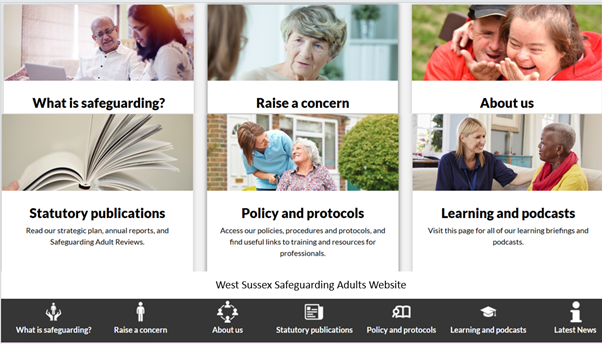 Screenshot of the Sfeguarding Adults website landing page
The above image is a screenshot of the Safeguarding Adults website page (opens in new tab). The West Sussex Safeguarding Website provides a wealth of further information, guidance, and education.
 The West Sussex Safeguarding Adults Board is a multi-agency partnership, with representation from statutory and voluntary partner organisations. The Board was established to promote the well-being of adults who have care and support needs, and to work collaboratively with agencies to prevent abuse and neglect where possible.
WSFRS SOP - Safeguarding Adults and Children at Risk
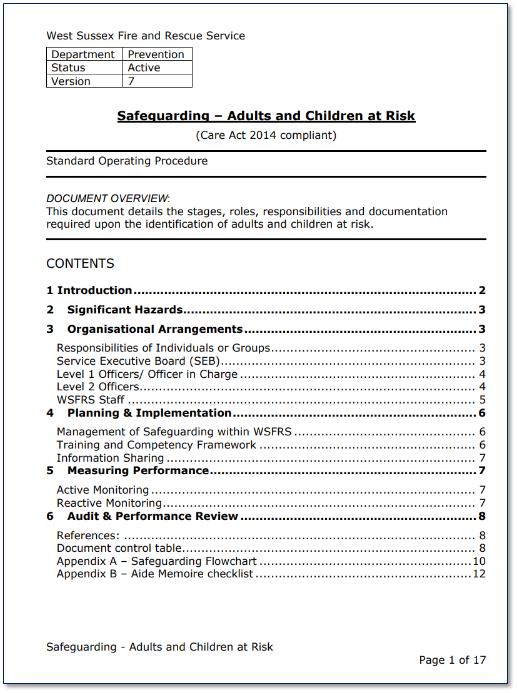
Click to access latest version of the WSFRS SOP (opens in new tab). It is also available in documents on the right od this page.
West Sussex Fire and Rescue Service (WSFRS) personnel, whilst on duty or outside work, may encounter or become aware of concerns relating to adults and children who are at risk from abuse, neglect or exploitation.
The risks encountered may well not be specifically fire related however all staff have a moral duty to ensure that people identified as being at risk receive appropriate support through safeguarding.
Safeguarding is everyone’s responsibility and any failure to deliver could constitute a significant organisational risk to both WSFRS and WSCC.
In order to fulfil the Service’s safeguarding obligations a robust 24-hour referral process and ongoing monitoring systems are required.
This SOP outlines the procedures for raising a concern whether it arises at an incident, Safe and Well Visit (SAWV), during routine duties or outside work. It also sets out procedures for monitoring repeat attendance and referrals and for receiving referrals from an outside agency.
This SOP adheres to the Pan Sussex Adult Safeguarding Procedures 2024 and Pan Sussex Child Protection and Safeguarding Procedures 2024
Three Qualifying Adults Safeguarding Questions to make a referral to Adult Social Care Safeguarding Hub.
1. What are care and support needs?
Care and support needs refer to the practical, financial, and emotional help adults require to manage daily life, maintain independence, and protect their wellbeing. Under the Care Act 2014, eligibility for local authority support is based on specific daily outcomes, an underlying physical or mental impairment, and overall impact on daily living.
These needs may already be supported by friends/family/ or professional carers – but they may also be ‘unmet’ where there is no current support.
A full list is provided in the Safeguarding Adults and Children SOP in Appendix A
2. Are they experiencing abuse and neglect?
You can identify if someone is experiencing abuse or neglect by watching for sudden behavioural changes (especially in the presence of another person), unexplained physical injuries, or basic living needs are unmet.
3. Are they unable to protect themselves?
Does the person have any conditions or circumstances making them unable to protect themselves from suspected abuse or neglect? This might include physical or mental health needs, the impact of trauma, or cognitive impairments such as dementia, brain injury or learning disability.
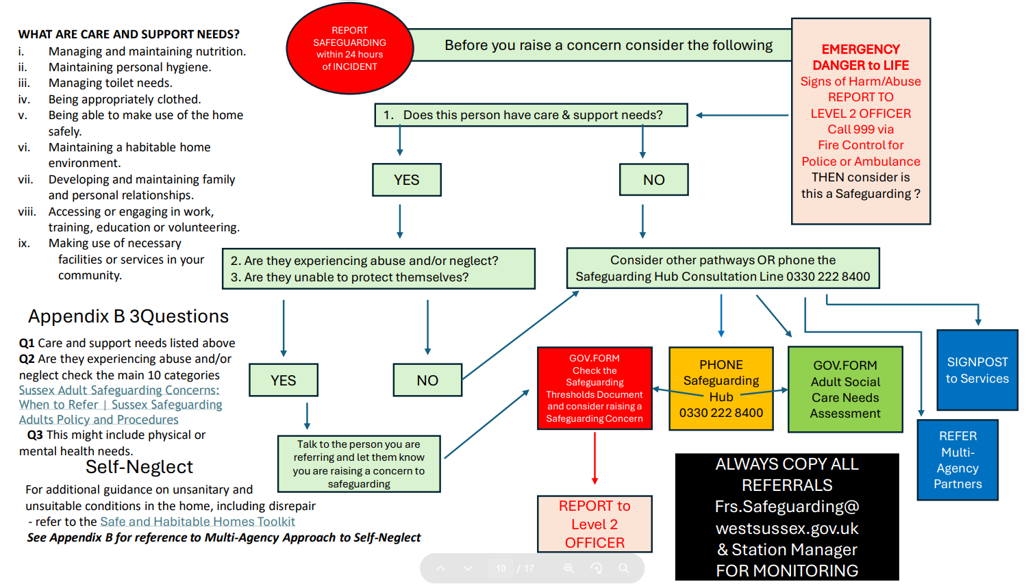
Within the Safeguarding Adults and Children SOP (opens in a new tab) you will find Appendix A in the Safeguarding Flowchart (illustration shown here on the right) where there is a full list of Care and Support Needs and provides direction to Appendix B to further explain the 3 Question Criteria to make a referral to the Safeguarding Hub at Adult Social Care.
For a clearer picture of the flowchart illustrated here, you will find in Appendix A of the Safeguarding Adults and Children SOP
A view of this chart is made available on the MDT in the cab computer.
Safeguarding Adults Thresholds - RAG Rating
When you open the new Sussex Safeguarding Adults - When to Refer (opens in a new tab) you can select from each category of safeguarding concern which is colour coded with the acronym RAG RED - AMBER - GREEN and aligned for direction in the flowchart. You will find the Safeguarding Thresholds presented as subject boxes to click, open in the document, and explore.
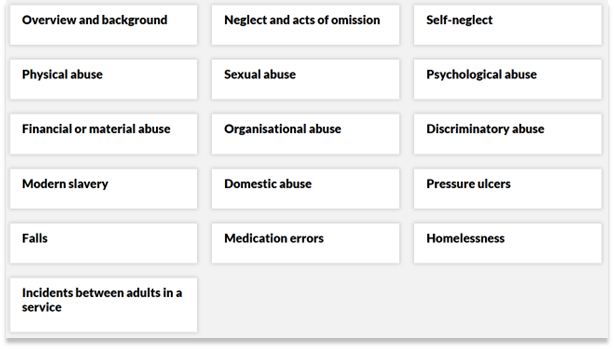 View of the categories of safeguarding taken from the website
IF A PERSON IS IN IMMEDIATE DANGER REPORT TO LEVEL 2 OFFICER and CALL 999 via FIRE CONTROL for POLICE or AMBULANCE
SAFEGUARDING CHILDREN
What does Child Protection look like in Practice?
CHILD: In the case of a child protection concern, no consent for referral is required.
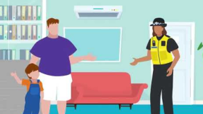 Everyone plays an important role in safeguarding children
Safeguarding and promoting the welfare of children is defined for the purposes of this guidance as:
- * protecting children from maltreatment;
- * preventing impairment of children's health or development;
- * ensuring that children grow up in circumstances consistent with the provision of safe and effective care;
* and taking action to enable all children to have the best outcomes.
The WSSCP Continuum of Need/ Threshold Guidance provides guidance and information in Child Protection Practice.
West Sussex Multi-Agency Guidance Protection of Children (opens in a new tab)
Children's Safeguarding Thresholds-on-a-page (opens in a new tab)
- your guide for identifying the right support at the right time.
- helps you recognise when a child or family may need additional support.
- provides consistent language across all services
- and is an everyday reference document which can be used in your supervision conversations and when working with partners.

| LEVEL 1 - Green - Children whose needs are fully met and thrive. Services open to all. | LEVEL 2 - Blue - Children with some emerging needs. Consent required to access services. | LEVEL 3 - Amber - Children with multiple complex needs. Consent required to access services. | LEVEL 4 - Red - Children with acute needs including those in need of protection. Consent required unless immediate safeguarding concern. |
1. Developmental Needs - Health
2. Developmental Needs - Learning & Education
3. Developmental Needs - Social and emotional presentation/behaviour/identity
4. Developmental Needs - self-care and independence
5. Family and social relationships
6. Housing, employment and finance
7. Parents and Carers - Basic care, safety and protection
8. Parents and Carers - emotional warmth and stability
9. Parents and Carers - guidance, boundaries and stimulation
The Integrated Front Door (IFD) one pathway to Children's Social Care and Early Help
All enquiries/referrals for both Social Care and Early Help come through a single front door referred to as the Integrated Front Door (IFD), this is the only public contact point for Early Help and Children’s Social Care. The IFD for West Sussex Children Services ensures that all enquiries and referrals are triaged upon receipt and directed to the appropriate service to support with the query, providing a seamless process with children receiving a service proportionate to their needs in a timely way. This expertise of the team comprises of qualified Early Help specialists, qualified Social Care specialists, qualified managers, Customer Service Centre Agents and social care referral advisors.
All Safeguarding referrals are submitted through the WSFRS .GovService Form for Safeguarding by choosing either Adult or Child where it indicates "go here " as in the example view below 🔻
Making a Safeguarding Referral for Adults and Children on the GovService Form
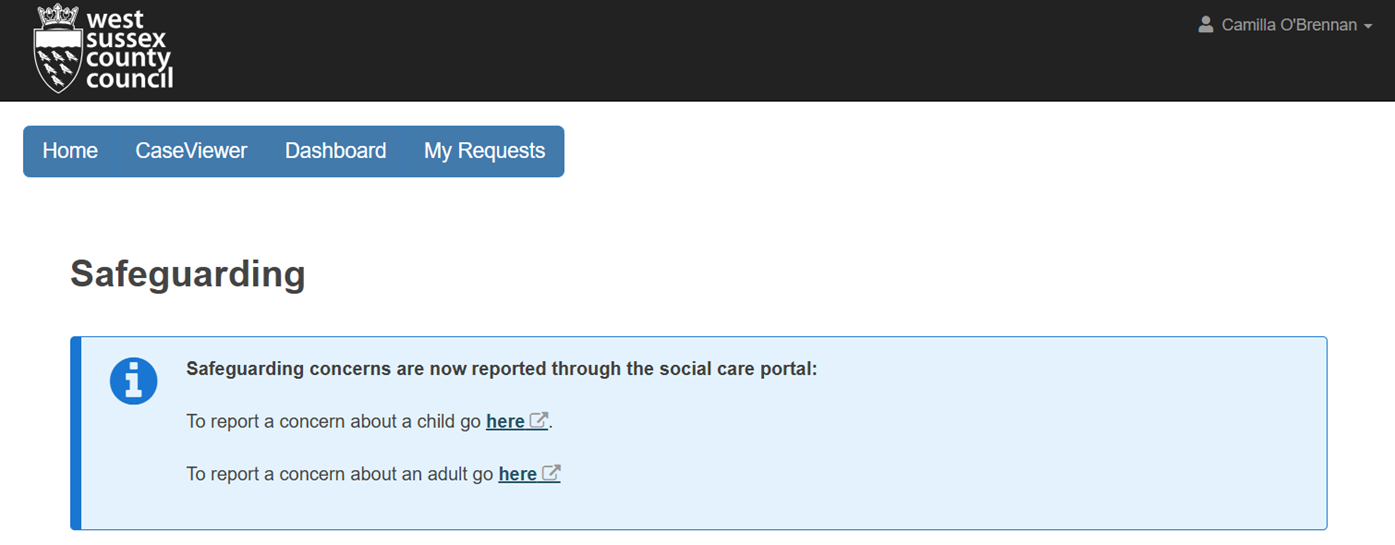 Screenshot of the online Sharepoint Safeguarding Portal for child or adult
COMMUNITY RISK MANAGEMENT CRM06 KPI
Report a safeguarding within 24 hours of incident call.
Any queries around safeguarding risk or concerns do not hesitate to get in touch with the WSFRS Safeguarding Leads or the WSCC Safeguarding Hub. Please refer to the Directory of Contact in the documents section for further multi-agency professional advice and guidance.
Accessibility and alternate formats
If you require any of this information in an alternative format, then please contact us via email at WestSussexLNRS@westsussex.gov.uk(External link) or by telephone on 01243 642105 and we will do our best to assist you. If you are deaf or hard of hearing and have a BT Relay UK app (opens in new window) installed on your PC, laptop or smartphone, you can contact us on 18001 01243 642105.
For more information about the accessibility of this website, please see our Accessibility tab (opens in new window) at the foot of the page.
Please note, you can use the Google Translate function to access this project in a range of different languages. The Google Translate widget can be found at the top left-hand side of the project page, where it sits just above the black West Sussex County Council ribbon.
-
Sussex Safeguarding Change of Threshold Document
Share Sussex Safeguarding Change of Threshold Document on Facebook Share Sussex Safeguarding Change of Threshold Document on X (formerly Twitter) Share Sussex Safeguarding Change of Threshold Document on Linkedin Email Sussex Safeguarding Change of Threshold Document link
 Sussex Adult Safeguarding Concerns: When to Refer The Safeguarding Adults Thresholds: Guidance for Professionals (2023) has been reviewed and rebranded as the Sussex Adult Safeguarding Concerns: When to Refer (2026).
 This guidance is to be used across Sussex to support professionals, partners, and providers to decide on whether to report a safeguarding concern for an adult with care and support needs. Within the guidance you will find information about preventative approaches; understanding concerns that are non-reportable, reportable, and those that require consultation; with examples of each category of concern and type of abuse.
Please ensure that you delete any copies of the Safeguarding Adults Thresholds: Guidance for Professionals (2023), and refer directly to the new guidance:
Sussex Adult Safeguarding Concerns - when to refer (opens in new tab)
-
SB
-

-
KT
-
WF

-
 Ben's story in his own words - overcoming abuse
-
 Working together to meet the legal and moral requirements expected of the Fire Service.