

Safe and habitable homes
The Safe & Habitable Homes Peer Forum
 A Community Initiative Partnership to address self-neglect in related to health, safety, and housing standards. The Forum is made up of customer-facing practitioners from housing, health, social care, mental health, community safety, care providers, and support services: to share good practice to sustain people with self-neglect concerns in suitable and safer homes for the benefit of their health and wellbeing in order for them to remain in the community. The collaborative aim is to avoid residential care, hospital admission and loss of life. The Forum focuses particularly on hoarding or filthy and verminous conditions, and recognises that cases may be further complicated by eviction, cuckooing, substance misuse, domestic abuse, disrepair, and for some people who have been re-housed when previously homeless.
The Forum of a multi-agency of partners, provides practical advice, guidance, and innovative solutions to practitioners. This is based on a strength-based and person-centred approach. Where appropriate, bespoke packages for people that could not be achieved with a ‘usual-care’ approach may be explored. Hoarding and/or Diogenes is complex and can be related to many other concerns that impact managing a safe and suitable home.
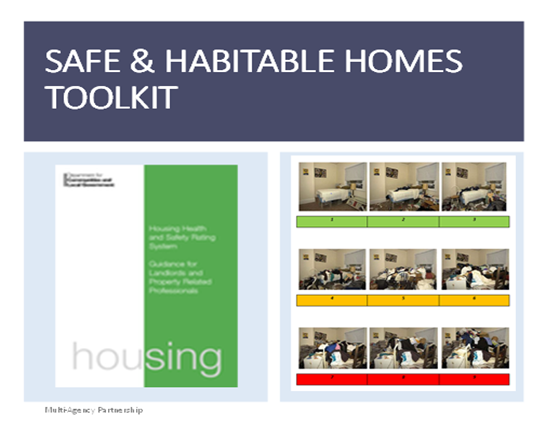
The Forum promotes a step-by-step approach though Safe & Habitable Homes Toolkit (opens in a new window) to support partners to be consistent in practice.
Safe and Habitable Homes references the guidance provided under Safeguarding Adults Board - practice, procedures, and protocols (opens in a new window)
A Case Management Enquiry can be presented at the Forum for any person living in West Sussex who is over 18 years old and there is a professional concern of self-neglect related to suitable, safe, and habitable housing. All cases presented at the Forum will be anonymised and confidential. As a Peer Forum, membership to the meeting is open to West Sussex professional practitioners.
Email for invitation to Safe & Habitable Homes Peer Forum housing4health@westsussex.gov.uk
Safeguarding and the Self-Neglect Multi-Agency Approach
Given the emotive nature of self-neglect and the associated risks, it is natural that professionals want to raise their concerns via safeguarding.
However, in all but rare cases, safeguarding isn’t the most appropriate way of providing support, and may well delay someone receiving the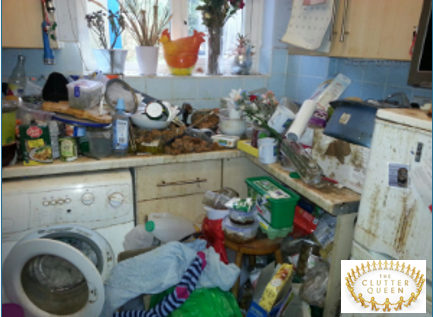 right support. This may be because the person does not meet the thresholds for a safeguarding enquiry, that is as they do not have care and support needs, and they understand the risk they are posing to themselves and can manage this situation.
It is recognised that self-neglect related to housing concerns is a complex situation and that a variety of agencies will come into contact with the same person. Hoarding is now also, recognised as a mental health diagnosis (DSM V). Not all those who hoard will meet criteria for support from statutory services such as Mental Health.
Research and experience shows that the best outcome for those who self-neglect, is for all agencies to work with the person at their pace, using different methods of encouragement, whilst remaining non-judgemental and exploring different options for support. The Peer Forum and the Toolkit are designed to support the team-around -the-person approach, for the multi-agency practitioners to create a joint-action-pan.
Safe & Habitable Homes Toolkit STEP-BY-STEP: INDEX
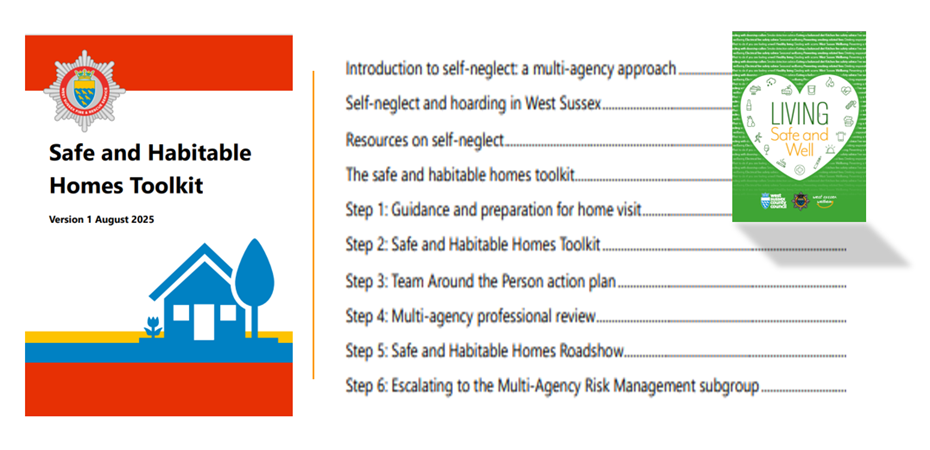
Safe & Habitable Homes Toolkit Page 2 (opens in a new window)
Safe & Habitable Homes Toolkit STEP ONE: Preparation for the visit
Your first visit to the home is an opportunity to connect with the person. The person-centred approach with personal involvement in the process is key to long-term collaboration towards a resolution. You may need to come back on several occasions before you gain access to the home, and indeed it may be some time until you may be invited to access other parts of the property.
How to talk to someone with hoarding behaviours (opens in a new window)
Respectful language involves using non-judgmental terms like "hoarding behaviours" instead of "hoarder," avoiding words like "junk" or "rubbish," and focusing on "letting go" rather than "throwing away," to acknowledge the deep emotional connection people with hoarding disorder have with their possessions, as language can trigger shame and resistance, while supportive communication focuses on the person's safety and needs.

[Edited from original source: Cristina M. Sorrentino, PhD, LCSW, Boston University School of Social Work]
Safe & Habitable Homes Toolkit STEP TWO: Home Audit Assessment Tools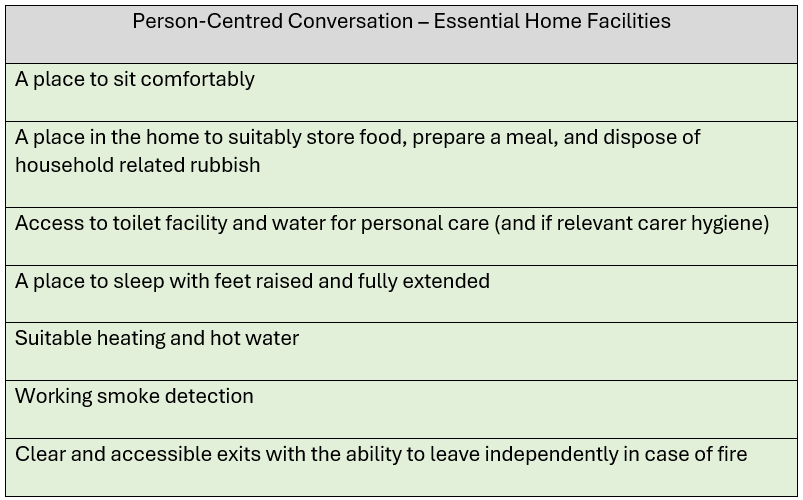
The resources for reference and guidance to complete the Home Audit Assessment with the person and to record their thoughts and wishes, are presented in the Safe & Habitable Homes Toolkit and aligned together through RAG (Red/Amber/Green) RATING.
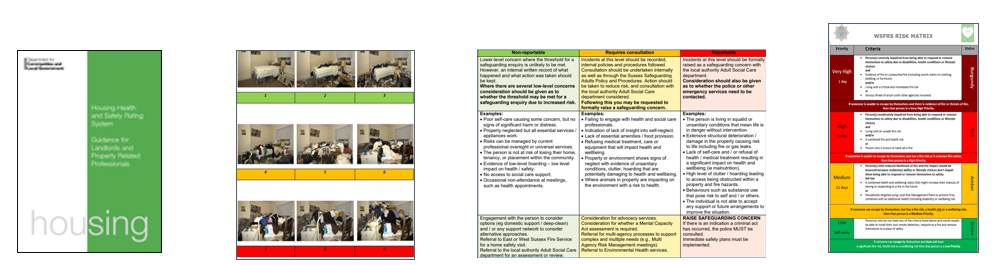
Housing Health & Safety Rating System - Clutter Rating - Safeguarding Thresholds - Fire Risk Matrix
Safe & Habitable Homes Toolkit STEP THREE: Team Around the Person & Action Plan
Using the Peer Forum & CLIO3 (community local information) database to bring together practitioners and services to create a person-centred team-around-the-person TAP. Using the Joint-Action-Plan Framework available in the Toolkit to identify needs and assign actions to the subject experts to collaborate and share resources, support hours, and funding opportunities.
Safe & Habitable Homes Toolkit STEP FOUR: Multi-Agency Partnership Review
A team-around-the-person approach to monitor and collaborate on the Joint-Action-Plan developed by the TAP Team. Meeting periodically at least every 4-6 weeks to record and re-evaluate progress for the person.
Safe & Habitable Homes Toolkit STEP FIVE: S&HH Membership and Forum Resources
 A monthly on-line peer meeting opportunity to explore learning, education, and case study support.
AGENDA
WELCOME & INTRODUCTIONS
CASE DISCUSSIONS
GOOD PRACTICE
S&HH PEER FORUM UPDATES
ROUND ROBIN - SERVICE NEWS
Please direct any Safe & Habitable Homes Peer Forum case management enquires to housing4health@westsussex.gov.uk
Safe & Habitable Homes Toolkit STEP SIX: MARM and Complex Case Risk Management
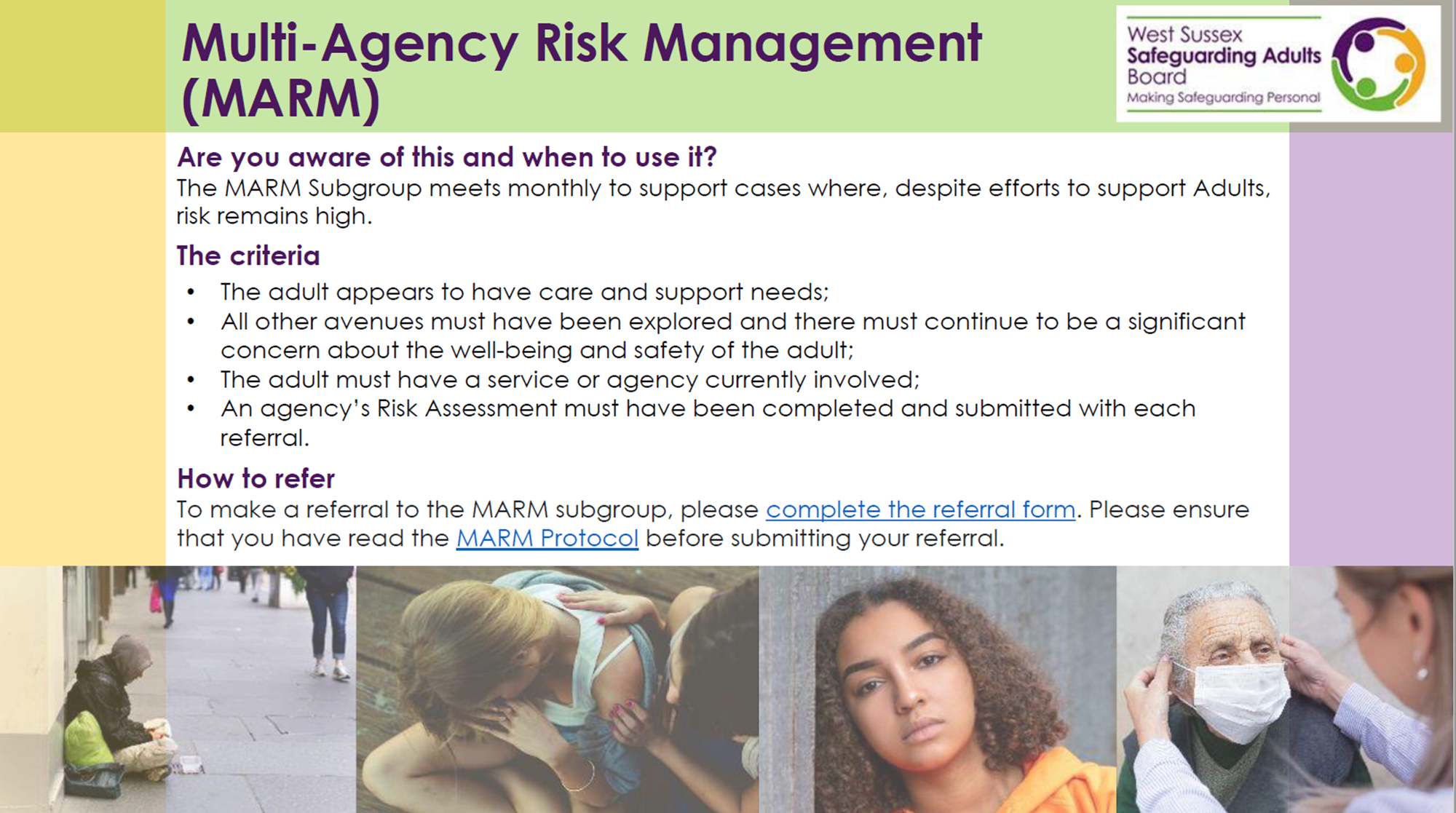
MARM Application Flyer (opens in new tab)
Accessibility and alternate formats
If you require any of this information in an alternative format, then please contact us via email at WestSussexLNRS@westsussex.gov.uk(External link) or by telephone on 01243 642105 and we will do our best to assist you. If you are deaf or hard of hearing and have a BT Relay UK app (opens in new window) installed on your PC, laptop or smartphone, you can contact us on 18001 01243 642105.
For more information about the accessibility of this website, please see our Accessibility tab (opens in new window) at the foot of the page.
Please note, you can use the Google Translate function to access this project in a range of different languages. The Google Translate widget can be found at the top left-hand side of the project page, where it sits just above the black West Sussex County Council ribbon.
-
Care Knowledge Webinar Thursday8th Oct 2026
Share Care Knowledge Webinar Thursday8th Oct 2026 on Facebook Share Care Knowledge Webinar Thursday8th Oct 2026 on X (formerly Twitter) Share Care Knowledge Webinar Thursday8th Oct 2026 on Linkedin Email Care Knowledge Webinar Thursday8th Oct 2026 link
-
Helping Hoarders - The Guardian Article
Share Helping Hoarders - The Guardian Article on Facebook Share Helping Hoarders - The Guardian Article on X (formerly Twitter) Share Helping Hoarders - The Guardian Article on Linkedin Email Helping Hoarders - The Guardian Article link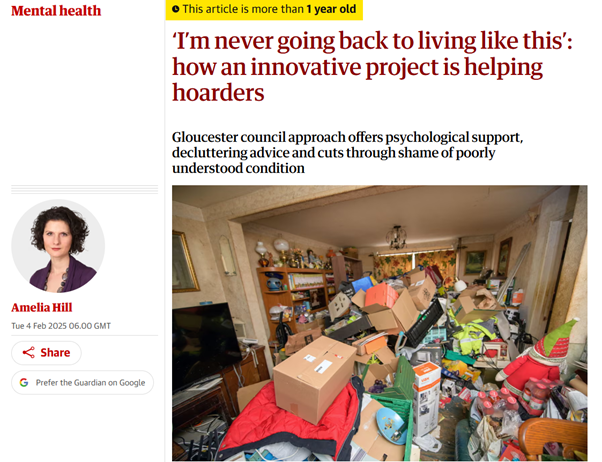
For the full article I’m never going back to living like this’: how an innovative project is helping hoarders | Mental health | The Guardian (opens in new tab)
Prof Sharon Morein, a member of the UK Hoarding Network and Partnership, agreed. “There is a huge lack of recognition and funding for hoarding but things are starting to change: our network includes over 200 professionals from various sectors. We’re passionate about spreading awareness and expertise, and slowly, local authorities are beginning to listen.”
For sufferers such as Carol, Gloucester’s approach is literally a lifesaver. “I was on the verge of not being here any more,” she admits. “But because of this programme, I’ve cleared over three tonnes of paper from my front room alone. Then I’m going to start on the rest of the house and I can promise you this: I’m never going back to living like this. Never again.”
-
Tues 17th Feb 2025 - Megan Karnes: Hoarding UK Special Edition S&HH Peer Forum Speaker
Share Tues 17th Feb 2025 - Megan Karnes: Hoarding UK Special Edition S&HH Peer Forum Speaker on Facebook Share Tues 17th Feb 2025 - Megan Karnes: Hoarding UK Special Edition S&HH Peer Forum Speaker on X (formerly Twitter) Share Tues 17th Feb 2025 - Megan Karnes: Hoarding UK Special Edition S&HH Peer Forum Speaker on Linkedin Email Tues 17th Feb 2025 - Megan Karnes: Hoarding UK Special Edition S&HH Peer Forum Speaker link
Megan Karnes (Chair & Director Hoarding UK) will be presenting 'A Real Life Perspective' to the Safe & Habitable Homes Peer Forum on Tuesday 17th February 2026 at 10:00 am.
Founded in 2008 by Megan Karnes – who whilst running another national mental health charity – realised that people with hoarding disorder were not being treated the same as people with other mental health disorders. Megan Karnes, is currently undertaking post graduate studies through Middlesex University. Her qualifications include Counsellor BA (Hons)., Dip. Clinical Supervision and Consultancy, Prim. Cert CBT, National Advocacy Qualification, Independent Mental Health Advocate, Registered MBACP. She came into Mental Health as an Organisational Development Consultant with experience transforming existing and building start up divisions and companies within the private, statutory and third sectors.
HoardingUK is the only UK National Charity solely focused on supporting people impacted by hoarding behaviour, with the aim to empower individuals experiencing hoarding behaviours to achieve spatial and personal change to improve their health and wellbeing, to improve practice amongst professionals, to raise awareness and increase understanding. Hoarding is a complex mental health condition affecting an estimated 2–5% of the population.
From that activist launch, HoardingUK are now a multi-service organisation helping thousands of people each year through our National Helpline, Advocacy; Information Packs; a one-to-one in-home Support Service; a free Benefits Support Service, a national training programme for professionals and organisations including our award nominated (Chartered Institute of Housing/Inside Housing) psychological support groups.
This special edition session is open to both practitioners and individuals in the community who would like to learn more about the real life perspective of living with hoarding.
For your place at the Safe &Habitable Homes Special Edition Session - Please email housing4health@westsussex.gov.uk for your link to attend on MS Teams
-
Peer Forum Community News & Updates
Share Peer Forum Community News & Updates on Facebook Share Peer Forum Community News & Updates on X (formerly Twitter) Share Peer Forum Community News & Updates on Linkedin Email Peer Forum Community News & Updates link


-

-
Peer Forum Support (Invitations etc)

-
 Introduction to the home page and the theory around the workings of the Toolkit.
-
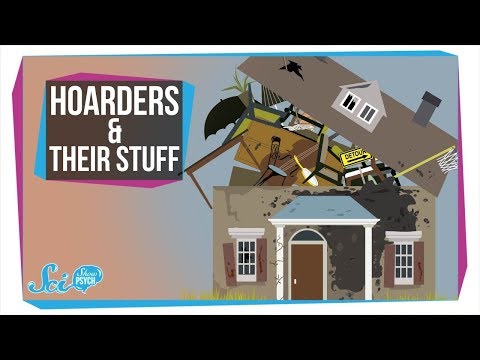 We all struggle with clutter, but something quite distinct might be happening in the brains of those who have the hoarding disorder
-
 A personal story of the impact of a lived-experience of loss.
-
