Fire Service Multi-Agency Info Hub
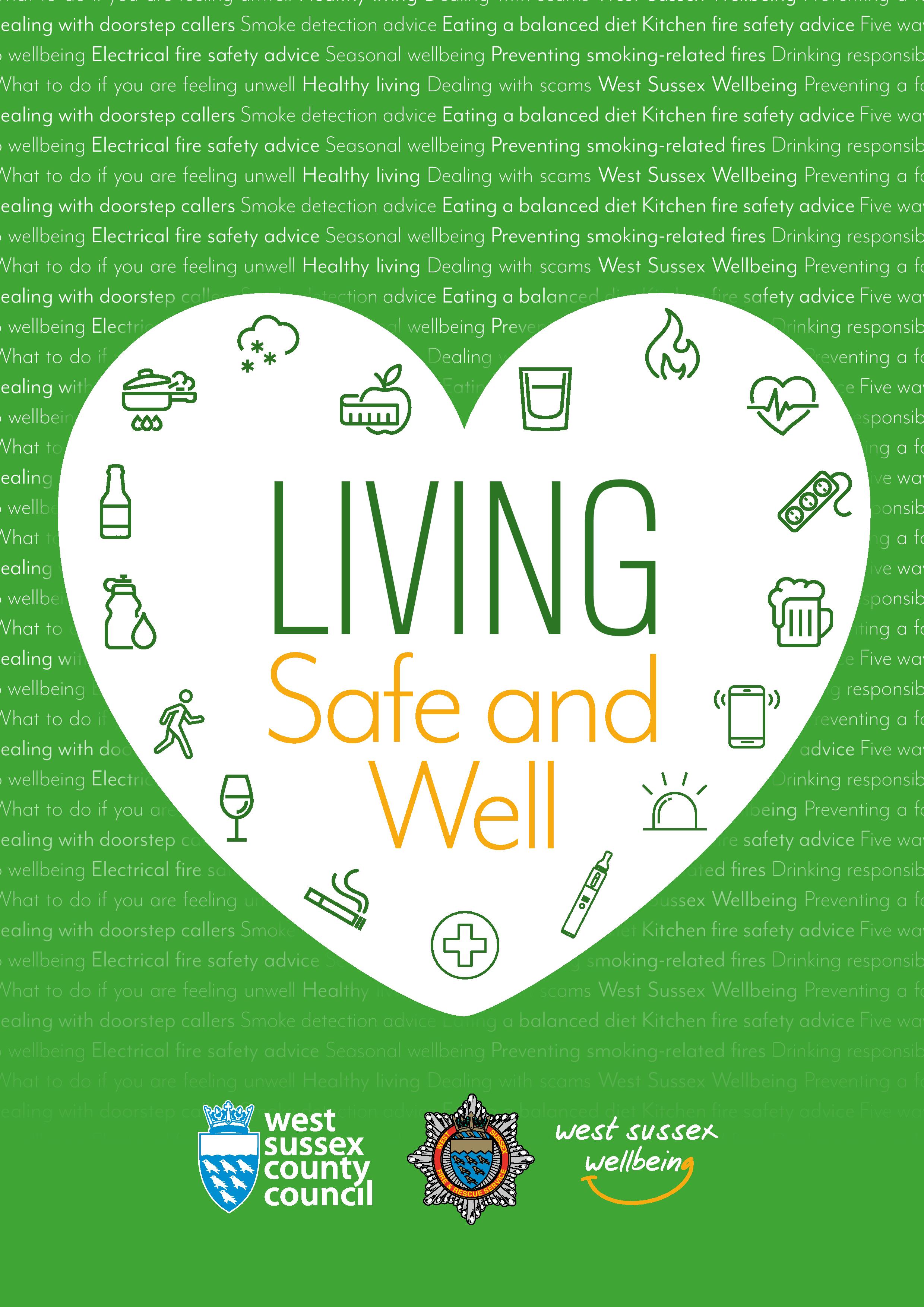
LIVING SAFE & WELL - WORKING IN PARTNERSHIP TO TARGET RISK
West Sussex Fire & Rescue Service (WSFRS) focus on targeting the most vulnerable people in the community who are at the highest risk of harm in the home. We seek to ensure access to our fire safety advice by promoting the prevention activity of the ‘Safe and Well Visit’. These home fire safety visits are an effective way of improving safety within people's homes.
West Sussex Fire and Rescue Service personnel will carry out Safe & Well Visits, giving advice and fitting smoke alarms/equipment where appropriate. A Safe and Well Visit is not an inspection but a conversation, for which the person must give consent for a visit to be carried out. These conversations often lead to advice and signposting to connect with other community partners in housing, health, mental health, social care, community safety including blue light services, care and support agencies.
Working in partnership to deliver Safe and Well prevention activity in collaboration with other agencies, our partners can identify and refer individuals in their caseloads and patient lists, ensuring we can collaborate to make every contact count and provide advice and guidance on not only fire risk, but link with other associated health and wellbeing support for those most vulnerable people in our community. Safe and Well visits are carried out with a person-centred approach. This means risk reduction measures can be identified and delivered jointly around the risk, health, behaviour, and social care needs of the person, taking into account their thoughts and wishes.
SAFE & WELL VISIT SLIDES & SOCIAL MEDIA IMAGES
In the library (right hand column) you will find a catalogue of information for your own learning, for sharing with your team, or to use for customer information.
Safe and Well Slides & Social Media Images - ready for use in newsletters and designed as compatible for TV monitor slideshows in community spaces such as GP Surgeries.
Safe & Well Visit Topics underpinning knowledge of the most common behaviours and risks highlighted in the Living Safe & Well booklet.
Seasonal Risks updated each month with seasonal and emerging risks.to initiate team discussion and review of patient and customer lists where there may have been changes since initial assessment which could indicate a need for a review of prevention activity and risk assessment.
Risk Data & Stats looking at serious and fatal fires to align with partners in identifying those behaviours and the set of circumstances to prevent the same happening again.
LEARNING AND EDUCATION
We have a range of talks and training sessions available to promote domestic home fire safety to customer-facing practitioners in the community. One of the following approaches may suit you as an individual or within your teams to suit your busy schedules. If you would like to learn more about availability please contact us through frs.fireandroadsafety@westsussex.gov.uk and quote LIVING SAFE AND WELL LEARNING and let us know which session from the outlines below.
SAFE & WELL VISIT 5Qs - when and how to make a referral through the professionals portal
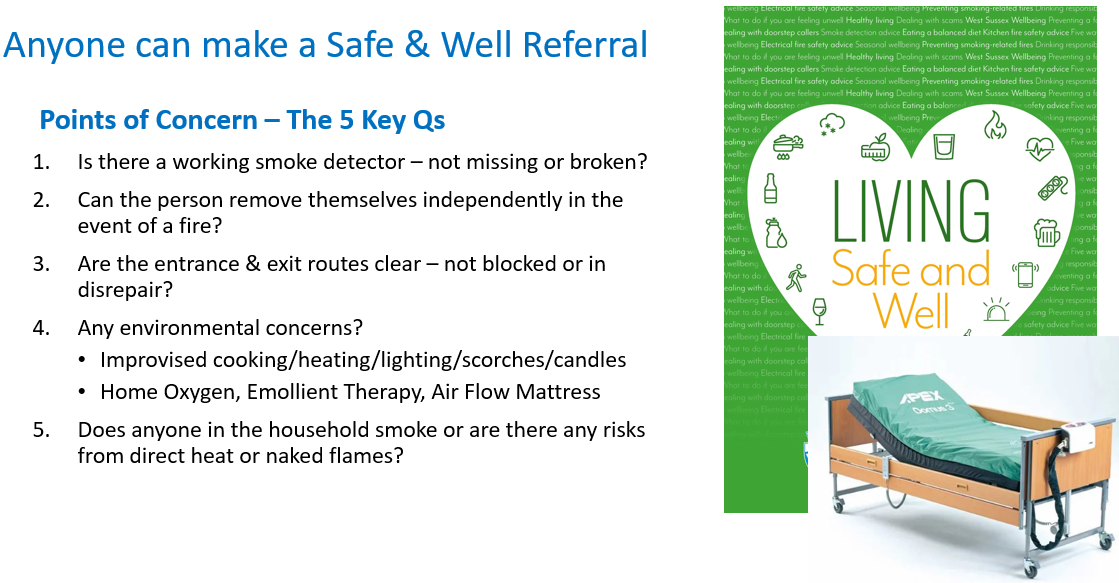 A basic introduction to the most common causes of accidental dwelling fires in the home. Identifying those people you are engaging with in your day-to-day who are most at risk, and learning about fire risk inequality where concerns for health and wellbeing can be an indicator in an increased risk of harm, admission to hospital, or loss of life due to an accidental dwelling fire. This session will provide the initial 5 quick qualifying question, how to make a referral to a Safe and Well Visit, and explore the benefits of supporting people in homes that are safer.
Session 20 minutes - can be delivered on-line or in person at lunch & learn, huddles, or team meetings.
FIRE RISK AWARENESS and intervention guidance
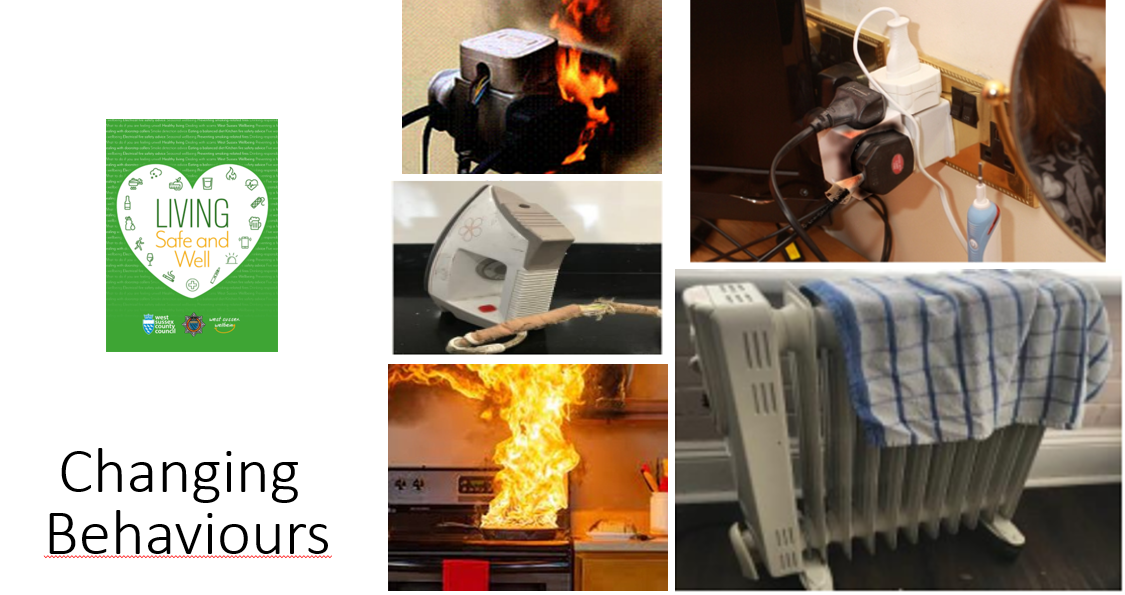 Looking at fire risk inequality and an in-depth look at the common hazards and behaviours for a professional to consider when visiting a person at home. Supporting the practitioner to be aware of smoke detection in the home with campaigns and encouraging testing such as #testittuesday, how many alarms should there be in the home, would a CO unit be recommended, and other practical observations. References to useful checklists and other resources.
Session 45 - 90 minutes - can be delivered on-line or in person to groups made up of multi-agency partners, teams, service training days etc.
MAFRAT - Multi-Agency Fire Risk Awareness Training
 This is delivered by multi-agency partners from fire, housing, health, social care, and environmental health. The session provides an in depth look at targeted fire risk awareness in the home and the collaborative approach to intervention, supporting reluctance to engage through multi-agency joint working, and the benefits of working in partnership in safer housing, self-neglect, health, and wellbeing.
We know through our incident data that certain groups are more likely to have an accidental fire in their home and they include people such as those living with Dementia, those with mobility restrictions, or mental health issues. Risk increases with age along with the potential for reduced mobility, sedentary smoking, and medical equipment such as oxygen, emollient creams, and air flow mattresses.
Although these risks are seen to be higher in the 65+ age group, these concerns are not age-limited. There are a number of groups we aim to identify and contact who aren’t necessarily recognised as being at a higher risk of fire, but they may not be accessing our services such as Safe and Well Visits or Reporting Fires because of other barriers which may be language, perceived prejudice, and other societal factors such as Domestic Abuse or Modern Slavery. Equality of access means actively seeking to engage these groups who may be unaware or choosing not to access services from us and other public sector providers.
In the Multi-Agency Fire Risk Awareness session, we also tackle concerns for self-neglect in the home, where a person may be living in an unsafe or unsanitary environment, or perhaps their home is showing signs of disrepair or energy inefficiency. We provide an introduction to the Safe & Habitable Homes Framework providing guidance on managing hoarding, Diogenes, and disrepair.
Sessions 3 hours - are held regularly on-line 4x per year.
This is offered to all customer-facing practitioners and is popular with those seeking to be develop as Fire Lead Subject Experts.
MAKING A QUALITY ASSURED REFERRAL
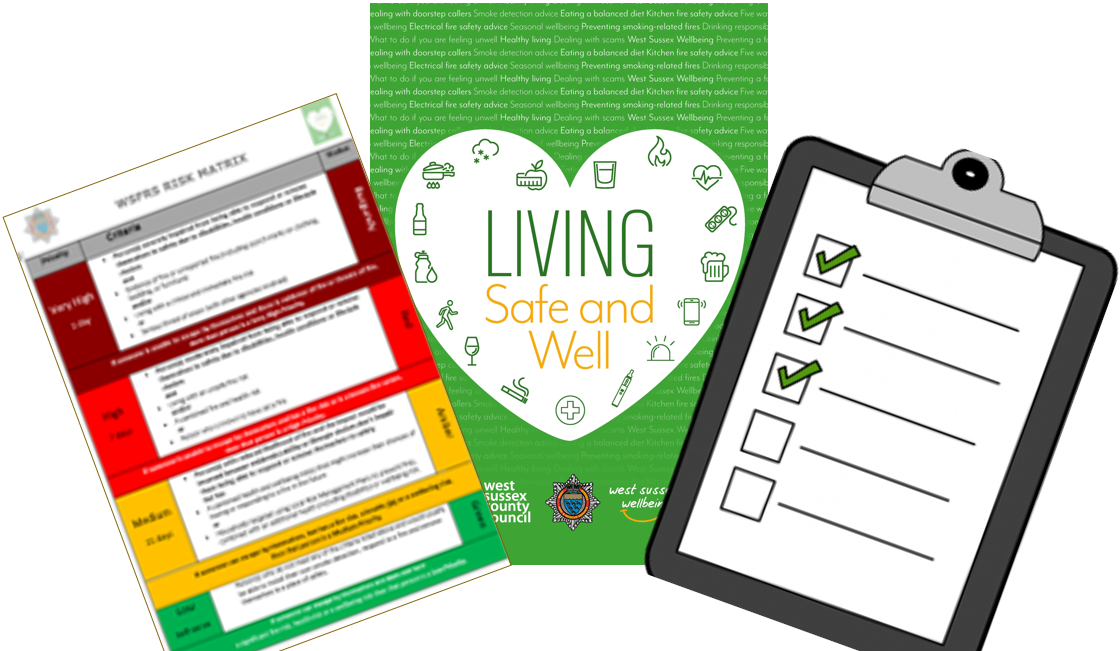 Reviewing the referral process to the professional Safe & Well Visit referral portal. Looking at the essential required information in relation to the fire risk matrix indicators for level of risk and time frames for contact with the referred person.
Session 45 minutes - can be delivered on-line or in person.
Accessibility and alternate formats
If you require any of this information in an alternative format, then please contact us via email wsfrs@westsussex.gov.uk (opens in new window) or by telephone on 01243 786211 and we will do our best to assist you. If you are deaf or hard of hearing and have a BT Relay UK app (opens in new window) installed on your PC, laptop or smartphone, you can contact us on 18001 01243 786211
For more information about the accessibility of this website, please see our Accessibility tab (opens in new window) at the foot of the page.
Please note, you can use the Google Translate function to access this project in a range of different languages. The Google Translate widget can be found at the top left-hand side of the project page, where it sits just above the black West Sussex County Council ribbon.
-
West Sussex Electric Blanket Testing 2026
Share West Sussex Electric Blanket Testing 2026 on Facebook Share West Sussex Electric Blanket Testing 2026 on X (formerly Twitter) Share West Sussex Electric Blanket Testing 2026 on Linkedin Email West Sussex Electric Blanket Testing 2026 link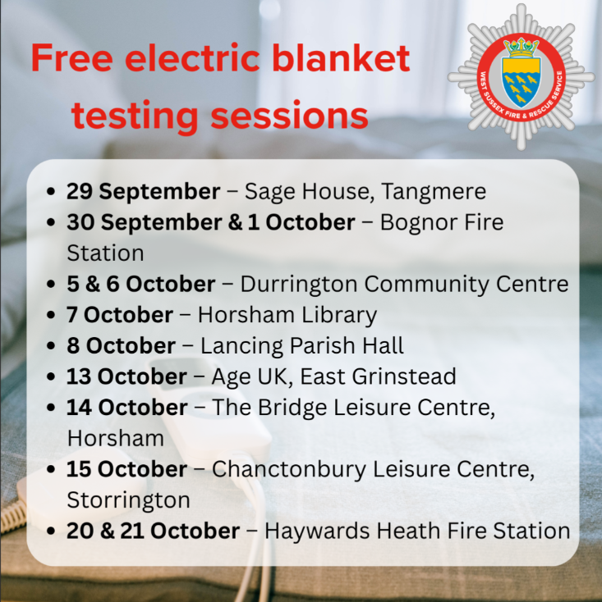 West Sussex Fire & Rescue Service Prevention team is getting ready to host a series of electric blanket testing sessions across the county this autumn. People can book an appointment to have their blanket tested on the following dates by calling 0345 872 9719.
Safety Risks for Fire and Burns:
Frayed wires, bunched fabric, or folding the blanket while turned on can trap heat and cause scorching or fire.
Age: Most fires involve blankets that are more than 10 years old.
Top Safety Rules
Keep it flat: Never use an electric blanket while it is folded, creased, or heavily bunched up.
Plug directly into the wall: Do not use extension cords or power strips, which can overheat.
Check the age: Replace your blanket every 10 years and avoid buying second-hand ones.
Inspect before use: Look for frayed cords, dark spots, or exposed wiring.
Turn it off: Switch off and unplug the blanket before you get into bed unless it features a certified all-night safety thermostat.