
FAQs
What is the West Sussex Public Chargepoint Network?
West Sussex County Council along with its district and borough partners in Adur, Arun, Chichester, Crawley, Horsham, Mid-Sussex and Worthing are working together to provide a network of publicly available electric vehicle (EV) chargepoints both on-street and in district & borough car parks.
How have chargepoint locations been chosen?
The proposed locations have been selected because either a member of the public has requested one in the area, or it has been identified that there is a need as there is little or no residential access to off-road parking and a lack of nearby public chargepoints.
Why do we need a public charging network?
In 2035, the UK government is banning the sale of new petrol and diesel vehicles to support the move to more environmentally friendly options and reduce our reliance on fossil fuels. Around 40% of drivers are without off-road parking therefore a network of public chargepoints is required so people without driveways can charge their EVs easily and conveniently.
More and more people are choosing electric vehicles, driven by shifting consumer preferences, technological advances, and a stronger push for sustainability.
The government is working towards phasing out the sale of petrol and diesel vehicles, highlighting the need to expand charging facilities and provide accessible chargepoints to those without off-road parking.
No one on our street has an EV, and I don’t want one, why are you installing here?
This may currently be the case, but there is a fast-approaching deadline at which point new internal combustion engine (ICE) vehicles will no longer be sold. It is important that we provide charging facilities for our residents enabling them the opportunity to move to an electric vehicle either now or in the future.
I don’t have an EV, will I still be able to park my car?
We’re not proposing to change any of the parking arrangements at the moment, so other cars will still be able to park as before, although we hope people will be considerate and allow EV drivers to charge. Any future changes to parking will be subject to a Traffic Regulation Order consultation.
What happens if you restrict the bays in the future for EVs only?
If in the future, EV’s are the dominant vehicle on West Sussex roads, WSCC will consider if there is a need to restrict the bays on a case-by-case basis. At this point, like any other implementation of a traffic regulation order (TRO), it would be subject to a full public consultation of the affected area.
Why can’t the chargepoint be installed in a nearby car park?
This phase of the LEVI Pilot Scheme is centred around on-street delivery. Subject to funding availability we may consider installing additional EV chargepoints in district and borough council car parks at a later date. We are not permitted to install chargepoints on private land.
Why switch to an electric vehicle?
EVs boast lower running and maintenance costs, as well as reduced emissions, this means cleaner air for everyone. With a growing second-hand market, increasing car leasing options, and vehicle tax exemptions, EVs are becoming more affordable for more people.
What will the chargepoints look like?
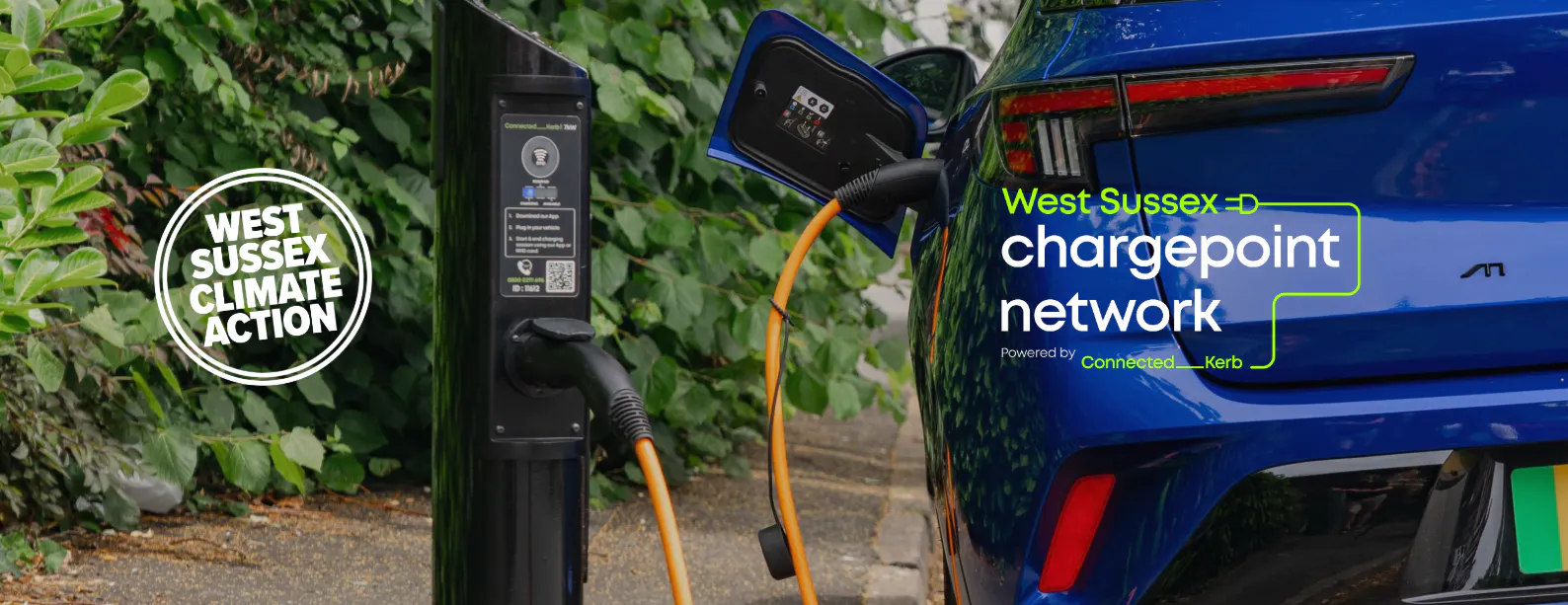
The chargepoints have been designed to be small and unobtrusive. Each 7kW chargepoint has two sockets, to allow two EVs to charge at the same time. There will also be a ‘feeder pillar’, to house the electrics, like other utility boxes you see on pavements.
This will allow us to future-proof our network by easily installing more chargepoints to meet increasing demand as more people move towards electric vehicles in the coming years.
Who is funding the installation and maintenance of the chargepoints?
The contract with Connected Kerb is a concession contract, meaning that West Sussex County Council and its district and borough partners are not required to contribute any funding towards this project. The project is also supported by the Office for Zero Emission Vehicles (OZEV) funding as and when available.
How do I find the locations of other chargepoints?
Download the Connected Kerb app via the Appstore or Google Play or visit zap-map (opens in new window)(External link) or Electroverse Map (opens in new window) (External Link)
What are the chargepoint tariffs?
Please refer to the charges on the Connected Kerb (opens in new window)(External link) page.
Where does the electricity come from?
Renewable energy sources primarily from wind, solar and hydro (water) sources will power 100% green electricity supplied by Octopus Energy.