
Frequently Asked Questions (FAQs)
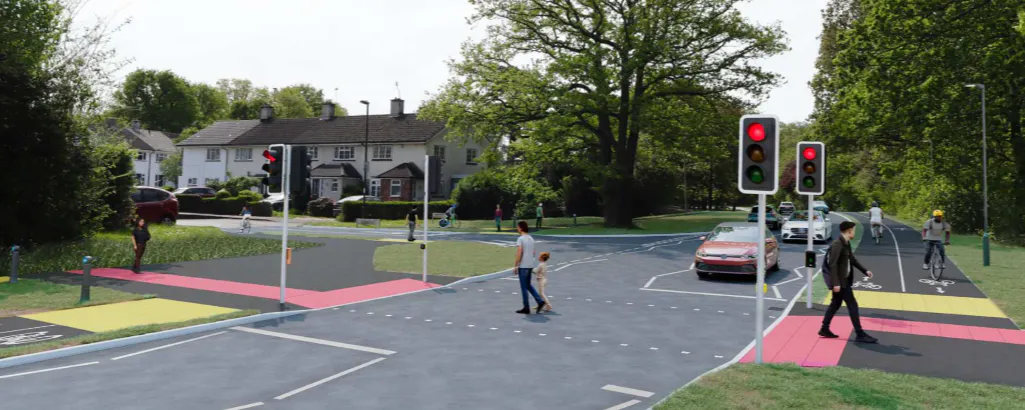
- Provide two-way cycle track on one side of Northgate Avenue, by removing some of the existing grass verge. The cycle lanes are in accordance with LTN 1/20 guidance, and will help provide a safer environment for cyclists away from general traffic and pedestrians;
- Upgraded controlled crossing facilities in proximity to Hermits Road and Gales Drive, on Northgate Avenue, including new dedicated crossings for those walking, wheeling or cycling; and
- Introduce a 30mph speed limit on Northgate Avenue to improve safety and driving conditions. Reducing the speed limit from 40mph to 30mph supports the proposed design and helps create a safer, more predictable environment for drivers by reducing collision risk and severity and encourages smoother traffic flow for all road users.
Why is the scheme required?
The West Sussex Transport Plan sets out an ambition to deliver sustainable transport improvements in Crawley, increasing connectivity and improving access to services and employment opportunities, including Gatwick Airport, where over half of staff live in Crawley.
At present, cycling and walking facilities across the town are disconnected and to a poor standard. The road network is also heavily congested, which creates an intimidating environment for cyclists and pedestrians, creating safety concerns and reducing the attractiveness of these modes.
The proposed improvements will help address the above-outlined issues, through the delivery of dedicated and high-quality cycle infrastructure which connects key sites across the town. The route, which starts at Crawley town centre, was featured in the Local Cycling and Walking Infrastructure Plan (LCWIP) for Crawley and has been identified as a priority for further investment.
The proposals align with the objectives set out in the West Sussex Transport Plan and will support wider initiatives to develop and regenerate Crawley town.
How is the scheme being funded and when will this be constructed?
Funding has been awarded by Active Travel England to develop the detailed design. This funding covers design, technical assessments, and consultation. Construction would be subject to future funding approvals.
As part of this design programme, a detailed costing exercise will be undertaken, with a Value for Money (VfM) assessment carried out. To be successful for future funding, the scheme would need to demonstrate good VfM, which cycling and walking schemes generally do.
What is being proposed?
The final designs are still under development, and the proposals could change depending on the feedback received throughout the consultation exercise. At a broad level, the scheme is looking to:
What standards are the proposals being designed to?
The project will seek to meet the guidance detailed for local authorities in the Government Local Transport Note 1/20: Cycle Infrastructure Design, along with Inclusive Mobility guidance. Beyond that, the Manual for Streets and Traffic Signs Regulations and General Directions (TSRGD) will be adhered to throughout.
How will people travelling in motor vehicles be impacted?
People who choose to travel by motor vehicle will continue to be able to do so along Northgate Avenue. The scheme is designed to make journeys safer and more reliable by reducing the speed limit from 40mph to 30mph, helping to lower the risk and severity of collisions and improve overall traffic flow.
The proposed walking, wheeling and cycling improvements are expected to encourage more people to use these alternatives for a variety of trips. This shift away from private car use has the potential to reduce the number of vehicles on the road, easing congestion and improving journey times for those who need to drive. Fewer vehicles and smoother traffic flow also contribute to improved air quality, creating a cleaner and more pleasant environment for motorists and residents alike.
Will the roads become narrower to allow for the new cycle lanes?
All general traffic lanes will be unaffected. On Northgate Avenue, the proposed cycle tracks will be accommodated by using part of the existing grass verge rather than the carriageway. This means there will be no reduction in road width for motor vehicles and no loss of capacity.
How will access to bus stops be affected?
Access to bus stops along Northgate Avenue will be maintained and improved. As part of the West Sussex Bus Service Improvement Plan, several stops are already planned for upgrades, and these have been designed to work alongside the proposed walking, wheeling and cycling improvements without conflict.
During the detailed design stage, careful consideration will be given to areas around bus stops to ensure they remain safe, accessible and convenient for all users. Measures may include features such as bus stop bypasses or clearly marked pedestrian crossing points across cycle lanes, helping to ensure smooth and safe movement for passengers, pedestrians and cyclists.
Does the scheme require any land take / is my property at risk?
At this stage, it is expected that most of the works can be delivered within the existing highway boundary or on land already owned by West Sussex County Council. This means there is no anticipated impact on private properties in most areas.
In some locations, however, discussions with neighbouring public landowners, Crawley District Council and Sussex Police, may be necessary to allow certain elements of the scheme to be designed and delivered as intended. Any such discussions would take place at an early stage, and no decisions would be made without engagement with the affected landowners.
What are you proposing for the subway under Crawley Avenue?
At this stage of the design, the scheme focuses on improvements between Dalewood Gardens and Crawley town centre. As a result, no changes are currently proposed for areas north of this, including the subway under Crawley Avenue.
Should future funding become available, further design work to better connect Manor Royal would be progressed. This would include reviewing the subway and considering any improvements that may be needed as part of a future phase.
Will any trees be impacted?
Some tree removal on Northgate Avenue may be required to deliver the proposed cycling paths; however, this will only take place where it is absolutely necessary and cannot be avoided through design. The scheme has been developed to minimise tree loss as much as possible, with priority given to retaining existing vegetation wherever feasible.
Where trees are unavoidably affected, this will be offset through a combination of new tree and shrub planting and/or regenerative landscape management on the open verges at the northern end of Northgate Avenue.
Regenerative management encourages natural tree and shrub growth by allowing areas to restock naturally from seeds dispersed by existing vegetation. Limited intervention, such as removing competing plants, may be used to support this process.
These approaches will be explored further during the detailed design stage, where opportunities to enhance biodiversity and green infrastructure will be carefully considered alongside the delivery of the cycling improvements.
Will parking be impacted?
To facilitate crossing improvements on Woodfield Road, there may be a small reduction in uncontrolled parking provision at the existing layby, opposite the existing access to the footway and cycle path. Please see the design proposals for further clarification.
How will you minimise disruption while the scheme is being constructed?
A construction phase plan will be developed once the outcome of the consultation is known. Prior to any construction works taking place, the impact of the works on local people, businesses, road users and the environment will be assessed, and mitigation measures designed.
What are the next steps?
We will carefully consider all comments received during the consultation. Feedback received will be used to inform the detailed design phase and the next steps for the proposal. We will document the process and publish the results in a consultation report.
Feedback from consultation will be used to shape the final proposals before any decision is made on progressing to construction.